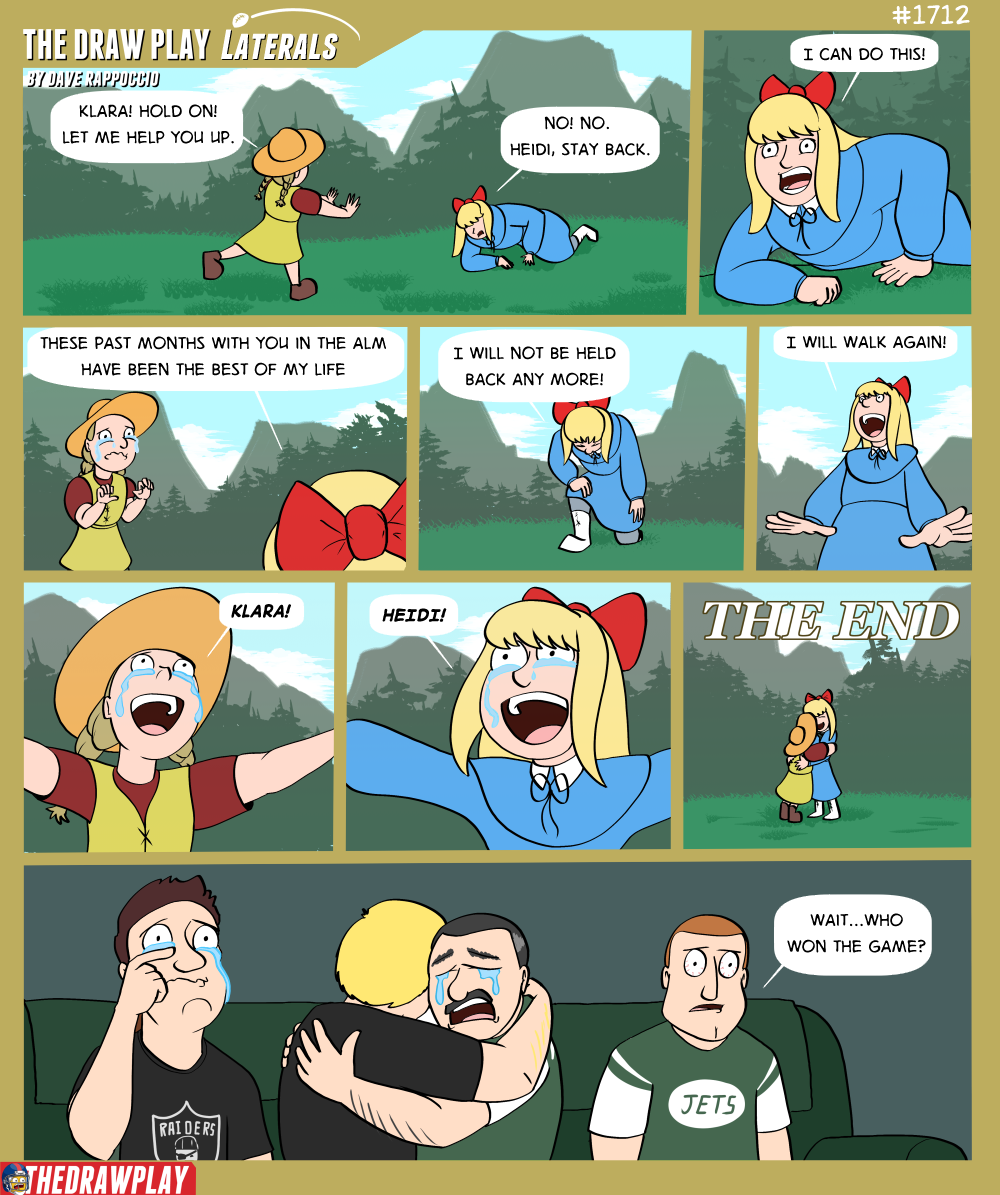

The Heidi Game
Heidi is a children’s novel written in the 1880’s about a little orphaned 5-year-old girl who goes on fun adventures in the Alps and in Germany and inspires the people around her. It is maybe the best-known piece of Swiss literature to exist and is beloved the world over. I can’t imagine author Johanna Spyri would ever understand that her seminal work of children’s fiction would one day decide how sporting events are broadcast in America.

Impossible to fathom today, but in 1968, the Jets and the Raiders are the two best teams in the AFL. [pause for laughter]. On November 17th, the two meet in Oakland for a much-anticipated matchup. It’s a great game. The two powerhouses trade blows with each other and keep the score tied late.
With just about a minute left, the Jets manage to break the tie between the two with a field goal to go up by three points. They kick off to the Raiders. They just have to hold off Oakland for one minute. They are not successful. The Raiders manage a huge TD after a Jets penalty and a 43 yard score. The Raiders are now ahead with 42 seconds left, and they have to defend the Jets.
The Jets fumbled the kickoff (I guess some things never change) and the Raiders scored again, ending the game 43-32. It was a wild finish to one of the best games of the year. But nobody outside the stadium saw it happen. At least nobody in Eastern or Central time.
The game ran a little bit long and at 7 o’clock sharp, NBC was scheduled to premiere a made-for-TV adaptation of the Swiss classic. It was a big deal, they’d been promoting it all night. And sure enough, right after the Jets kicked off post-field goal, the broadcast switched to Heidi.
As you can imagine, it was a shitshow from there. The phone lines at NBC were blowing fuses with people calling in. You have to remember that calling into the stations to complain was basically Twitter for 1960’s people. It probably even had the same amount of racism. NBC was unable to change back to the game, and everyone on the eastern side of the country missed a classic comeback.
The embarrassing part of the gaffe was that NBC saw it coming. The executives in charge of the sports broadcast could tell the game was going on too long and would likely go over the 7pm line. They called the president to warn him. Viewers even noticed that was going to happen, and many people were calling in to demand the game stay on, while others demanded Heidi not get delayed. The switchboards were blowing fuses and clogging the lines before the broadcast had even switched. This quagmire is partially why the communication between NBC broadcasting teams and headquarters was so jammed. The game had been given permission by the president to play out in full, but the failure to reach the director of broadcasting in time forced a decision. He chose Heidi.
The comedy of errors resulted in policy decisions to always allow sporting events to complete before switching off, a policy that was adapted by everyone else and is still in practice to this day. NBC even installed a direct phone line between offices and headquarters to prevent important calls from being clogged up on the switchboard by the public, kind of like the first Twitter DMs.
Heidi ended up being the most-watched television film of all time until Brian’s Song in 1971. Leave it to a football movie to beat it. You have to wonder how many of those viewers were just confused and angry football fans.
The Jets and Raiders would meet once more a month later to determine who would go to Super Bowl III. The Jets would claim their vengeance on Oakland and go on to make history. Maybe the lesson is that embarrassing Jets moments must always be broadcast in full, lest they unleash their true power on the league. The world has properly held them back since.

3 panel, should be “the Alps”, not “the alm”. I was confused for a sec, before context kicked in.
interesting story, didn’t know this one.
Heidi is more well known in literature than the William Tell stories?
I think the only William Tell story that popular culture knows is the apple shooting story
To prove your point even more I didn’t even know their were more William Tell stories.
He’s basically Swiss Robin Hood with a crossbow fighting against the tyranny of the Holy Roman Empire.
Yeah by a lot. Most people don’t even know where the apple on the head thing comes from
“…and the sports leagues and television broadcasters everywhere learned a valuable lesson about overscheduling games throughout the daily broadcast schedule and diluting the market. This has been your update from Alternate Earth.”
Good classic NFL story, though not sure why you needed to bring up racism in it. No need to write like your on Reddit when on your own site. They can’t hurt you here Dave!
The Raiders fan tears are perfect. While I’ve heard this story before I never realized it was the same year the Jets beat them in Superbowl III!
HUH?
A sure sign that a person isn’t racist is they freak out over a random throwaway joke making fun of racists.
Calling twitter racist = talking like I’m on reddit. Have you spent time on twitter? Lately? Man calling it racist is almost quaint at this stage when the fucking owner of the site is constantly outright sharing supremacist views
If anything I was being nice. It’s very interesting that that little throwaway line is the one that caught your attention
The Heidibowl, of all the unofficial Bowls in league history, feels the most accidental. Not just because of how unlikely the circumstances were to have this happen, but because I’m not sure it’s a massive deal unless the Raiders come back (whether the Jets successfully re-took the lead or not). And that’s just so unlikely in the 60s; teams scored 20 points per game, drives were longer, defenses more stout compared to today, and 1 minute scoring drives just so rare by comparison.
I can’t tell if this is showing my age (I say approaching 30) but I feel like the first few times I was told about the Heidibowl the person telling me about it didn’t bring up just how good the game had been; this would be a good claim for the game of the season in 1968 and would be a contender for game of the season in the modern day, and yet I rarely see that brought up when discussing the Heidi bowl, it’s usually just the cliff note of “raiders losing and came back”.
That’s a lovely story! I remember being captivated by Heidi’s adventures as a child too – it really does capture a special kind of childhood wonder.
I remember how South Park parodied that in the Charles Manson Christmas episode.
I don’t know what’s more unbelievable—that a nationally broadcast sports game on the last game of the season would be interrupted by a children’s movie, or that the Jets and Raiders were in the Super Bowl at the same time.
Times sure change.
Not exactly the SB but they were playing to get there that year. Probably one of the few times Jets bested the Raiders in a game that matters. *looks at the Jets getting cucked in the early 2000s by the Raiders*
It wasn’t the Super Bowl. This was an AFL regular season game. The Super Bowl that year was the famous Jets-Colts game that led to the AFL being taken seriously as a true competitor to the NFL and the two leagues merging.
Another comic idea: how the NFL stadiums that hosted World Cup games got grass for their fields and how the NFL doesn’t even do that for their own teams and has no plans to do so.
https://www.espn.com/nfl/story/_/id/49030490/fifa-world-cup-grass-nfl-stadiums-debate-field-surface
https://archive.ph/2026.07.10-131237/https://www.dallasnews.com/news/article/dallas-cowboys-world-cup-grass-field-jerry-jones-22339243.php
NBC actually put the final score of the game at the bottom of the scene in which Clara tries to walk again.
This game was also (so far) an eternal Scorigami, as brilliantly covered by Jon Bois: https://youtu.be/wsTEqRsUwTI?si=ssmBTok_A1TfG5xY&t=946